Building Mrs. Meyer’s Clean Day: Why Monica Nassif Knows That Not All Growth Is Good Growth
Getting your products into 250 Target stores sounds like the kind of milestone most consumer product entrepreneurs would celebrate. For Monica Nassif, it became an opportunity to make one of the more difficult decisions of her entrepreneurial career: walking away from a major retailer before the retailer walked away from her.
Her company had limited resources for advertising, and the stores selected for the test were spread across different markets rather than concentrated in areas where customers already recognized her products. Sales were disappointing, and although the distribution looked impressive on paper, the business was not positioned to support it.
Rather than continue pursuing growth that her company could not sustain, Monica pulled her products from Target, strengthened her presence in specialty grocery stores and Whole Foods, and continued nurturing her relationship with the retailer. When the business was better positioned to succeed, Target came back.
It is a particularly revealing story from the woman who built two recognizable brands in premium household cleaning, Caldrea and Mrs. Meyer’s Clean Day, before selling the business to SC Johnson in 2008.
An entrepreneur, brand builder, author, and 2020 inductee into the Minnesota Business Hall of Fame, Monica has spent her career identifying opportunities that others overlooked and challenging established assumptions about what consumers want.
In our conversation with Monica on the Badass Women in Business Podcast, we explored what it actually takes to build a consumer brand, from raising capital and negotiating with retailers to protecting margins and preparing a company for acquisition. What makes Monica's experience especially valuable is her willingness to talk about the decisions that were difficult, the opportunities she turned down, and the mistakes she made even after achieving considerable entrepreneurial success.
Moving From Selling Expertise to Building Something She Could Own
Before becoming a consumer products entrepreneur, Monica spent years helping other companies build their businesses. She worked as an executive speechwriter at Dayton Hudson, the former parent company of Target, before establishing Kilter, a marketing and design firm that served retailers and consumer product companies for more than a decade.
Through that work, she developed an understanding of consumer behavior, retail strategy, packaging, and how companies establish a meaningful position in competitive markets. She also began recognizing a limitation within her own business model.
As Monica describes it, the assets of her agency went down the elevator every evening.
Like many professional services business owners, she had built a company whose ability to generate revenue depended heavily on the people delivering the work. She wanted to create something that could be manufactured while she was sleeping, something that could grow without requiring a corresponding increase in the hours she personally invested in the business.
Her inspiration came during a visit to a home goods store in Atlanta, where she encountered a toppled pallet of household cleaning products. The packaging was unattractive, the colors were harsh, and the fragrances were anything but inviting.
Having worked with the beauty brand Aveda, Monica began considering why consumers could enjoy beautifully packaged, thoughtfully fragranced personal care products, yet had so few comparable options for taking care of their homes.
She saw an opportunity to introduce an entirely different experience into an established industry. Rather than treating cleaning products as purely functional household necessities, she envisioned coordinated fragrances, attractive packaging, and products that consumers would genuinely enjoy using.
That idea became the foundation for Caldrea, which Monica launched in 2000 as a premium household cleaning brand designed for specialty retailers and upscale grocery stores.
Her professional background, also explored in this University of St. Thomas profile, gave her valuable insight into the retail environment. However, understanding how to market products for other companies was very different from taking on the financial responsibility of manufacturing, distributing, and selling her own.
Monica recalls raising two rounds of angel investment of approximately $800,000 each and eventually growing Caldrea into roughly 4,000 to 5,000 stores. In moving from consulting to consumer products, she had created the opportunity to build a scalable asset, but she had also entered a business that required substantial capital long before the corresponding revenue arrived.
Why She Created Her Own Competition
As Caldrea gained traction, Monica recognized that she had uncovered an opportunity much larger than the premium specialty retail market.
She also understood that if her company did not find a way to reach a broader audience, a larger competitor with more resources eventually would. Rather than dilute Caldrea's premium positioning by introducing less expensive products under the same name, Monica decided to create an entirely separate brand.
As she explained during our conversation, she wanted to “knock off ourselves” before someone else did.
Mrs. Meyer’s Clean Day launched in 2002, bringing the concept of beautifully fragranced household cleaning products to a broader market at a more accessible price point. While the two brands shared a similar philosophy, they served different customers and operated with different pricing and cost structures.
Monica was challenging the conventions of an industry she describes as a $30 billion household cleaning market. She introduced products developed around coordinated fragrances, allowing consumers who loved lavender or basil, for example, to carry that same fragrance throughout their homes.
It was a sophisticated business decision that allowed Monica to pursue a larger market opportunity without compromising the identity she had worked so hard to establish with Caldrea.
The inspiration for Mrs. Meyer’s came from her mother, Thelma Meyer, an Iowa mother of nine whose practicality, work ethic, resourcefulness, and approach to caring for her family became central to the personality of the brand.
What Monica discovered, however, was that her mother's authenticity was far more compelling than anything a marketing team could manufacture.
She shared a particularly entertaining story about attempting to prepare Thelma for media interviews. Monica had developed key messages and wanted her mother to communicate them during interviews. Instead, Thelma would occasionally interrupt the conversation to ask Monica whether she had just delivered one of the key messages.
Eventually, Monica realized that the best thing she could do was let her mother be herself.
That authenticity helped establish a brand personality that consumers could recognize and connect with. At the same time, Monica understood that protecting that identity required more than relying on her mother's presence. Before selling the company, her team developed a comprehensive brand guide documenting everything from visual elements and packaging to the language and personality associated with Mrs. Meyer’s.
For founders whose businesses are closely connected to their own personalities, experiences, or family stories, there is an important distinction here. Building a brand around an authentic personal connection can be incredibly powerful, but creating an enduring business requires translating that connection into something others can understand, communicate, and carry forward.
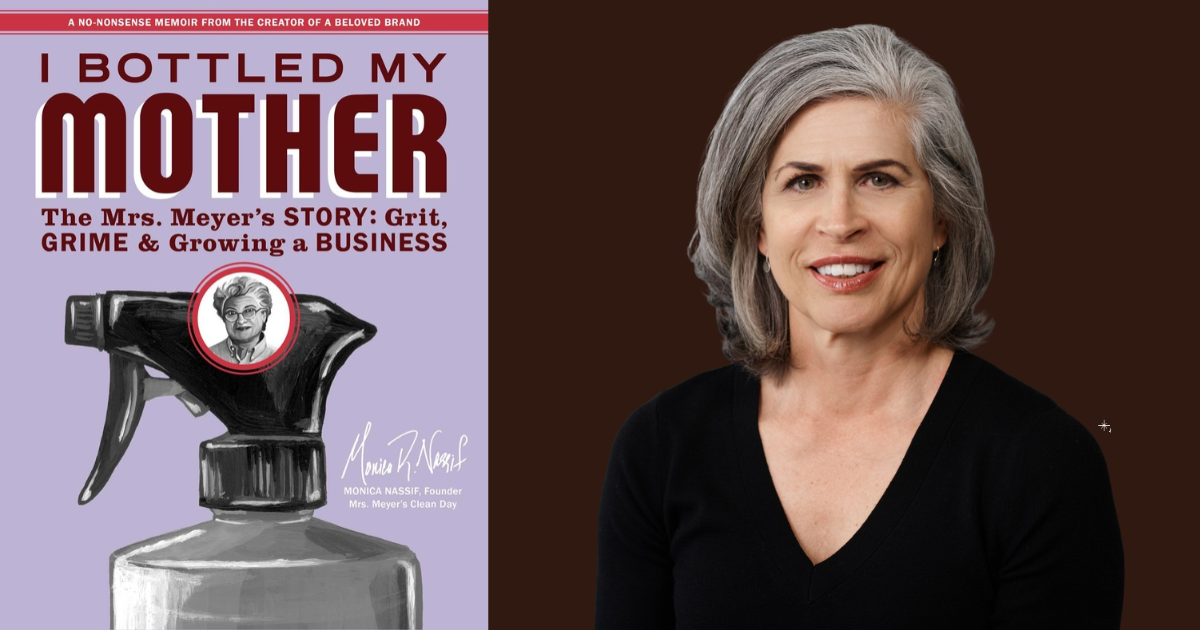
Monica explores her upbringing, her relationship with her mother, and the experiences that shaped her entrepreneurial journey in her book, I Bottled My Mother: The Mrs. Meyer’s Story, Grit, Grime & Growing a Business. Part memoir and part startup manual, the book offers a candid look at the personal and commercial decisions behind building a recognizable consumer brand.
Understanding What Customers Are Actually Willing to Pay
One of the more interesting aspects of our conversation was how Monica approached pricing.
Creating a beautiful product is one thing. Understanding how much customers are willing to pay for it, particularly when it sits alongside established competitors with significantly lower prices, is another.
Monica wanted her cleaning products to look like what she describes as “jewelry for the counter.” Rather than something consumers felt compelled to hide beneath their kitchen sinks, she wanted to create products they were happy to leave on display.
But attractive packaging and appealing fragrances were not enough to determine what the products should cost.
To better understand the opportunity, Monica visited grocery stores around Minneapolis and compared the prices of premium and conventional products across different categories. She looked at products such as mustard and olive oil, observing how much more consumers were being asked to pay for a premium experience.
Across her comparisons, she recalls identifying a price difference of approximately 25 percent, which became a starting point for developing the pricing strategy for Mrs. Meyer’s.
What we appreciated about this approach was its practicality. Rather than relying exclusively on what she believed her products were worth, Monica looked at existing purchasing behavior to better understand premium positioning in familiar categories.
Of course, establishing a retail price is only part of the equation. Manufacturing costs, packaging, shipping, retailer margins, promotional expenses, and inventory all influence whether a product can become a profitable business.
This is an area where many entrepreneurs struggle, regardless of industry. We can become so focused on what differentiates our products or services that we underestimate the importance of building a financial model that supports that differentiation. Customers may be willing to pay more for a better experience, but the business still needs to retain enough of that additional revenue to fund its operations and future growth.
When Getting Into Target Was Not the Right Opportunity
For consumer products entrepreneurs, securing distribution through a major national retailer often represents years of ambition and hard work. It can also create significant financial and operational challenges that founders are not necessarily prepared to manage.
Monica understood that without a substantial advertising budget, the retail shelf itself had to become one of her most effective marketing tools.
At Whole Foods, she worked to secure shelf space that allowed multiple products to be displayed together, sometimes creating a presentation of as many as 14 products. The coordinated packaging, colors, and fragrances communicated the identity of the brand in a way that a single bottle sitting among dozens of competitors could not.
She was even willing to turn down retail opportunities when the proposed product placement would not give the brand a reasonable chance of succeeding.
That same discipline informed her decision to withdraw from the initial test involving 250 Target stores.
Monica had wanted to concentrate distribution around markets where the company was already developing recognition through Whole Foods and other retailers. Instead, the stores were dispersed geographically, making it difficult to build awareness and generate sufficient sales with the resources available.
Rather than allow disappointing performance to damage the relationship permanently, she chose to withdraw the products and focus on strengthening the business elsewhere.
Importantly, walking away from Target did not mean abandoning the relationship. Monica continued meeting with the retailer, sharing what she was learning about the cleaning products category and offering valuable insights without constantly asking for another opportunity to sell.
When Target eventually came back, the business was better prepared.
Monica's experience also challenges the idea that every distribution channel should be evaluated according to conventional wisdom. When the company had the opportunity to manufacture private label products for Williams Sonoma, some of her board members questioned whether the opportunity was worthwhile.
Monica saw a retailer that valued quality ingredients, thoughtful packaging, and a meaningful product experience. She also saw a substantial order and an opportunity to introduce consumers to the company behind the products.
Rather than automatically dismiss the opportunity because private label manufacturing was considered less attractive, she evaluated it based on what it could contribute to the business.
Today, when entrepreneurs ask Monica how to get their products into retailers such as Target, Whole Foods, or Costco, she responds with a question that every consumer products founder should consider:
“Who are you going to kick off the shelf?”
A retailer has limited space and established products that are already generating revenue. A founder needs to understand why her product deserves that space, how she will support its performance, and whether she has the financial resources to fulfill the orders she is pursuing.
The same principle applies to businesses far beyond consumer products. Landing a major client, securing a large contract, or entering a new market can feel like validation, but those opportunities can quickly become liabilities when a company lacks the cash, capacity, or infrastructure to deliver profitably.
Sometimes the most important growth decision a founder makes is recognizing which opportunities the business is not yet ready to pursue.
Raising Capital and Finding Investors Who Understood the Business
Monica's experience raising capital offers another valuable perspective for entrepreneurs navigating the investment process.
Her first round of funding took approximately seven months, while her second took seven days. The difference was that by the time she pursued her second round, she had revenue. Rather than asking investors to believe entirely in a concept and financial projections, she could demonstrate that customers were purchasing the products and that the business was beginning to establish traction.
However, getting to that point required navigating considerable rejection, including assumptions about her ability to build a successful business as a woman.
Monica recalls approaching investors who had little personal familiarity with the household cleaning products category. She also encountered investors whose experiences with another woman entrepreneur had influenced how they perceived her investment opportunity.
She was being asked to overcome skepticism that had relatively little to do with her own capabilities or business concept.
Eventually, she adjusted her approach. Rather than spend an entire meeting trying to convince someone who had little interest in her category, she began asking for introductions to three people who might be better suited to the opportunity.
Those conversations became a way to expand her network and identify investors who understood the complexities of manufacturing, packaging, retail distribution, and inventory.
She also changed how she communicated the potential value of the business. By examining other consumer products categories where premium brands had successfully emerged and been acquired, Monica could help investors understand the broader market opportunity rather than relying exclusively on the appeal of her own products.
There is an important lesson here for founders pursuing outside capital. While securing funding can feel like the immediate priority, identifying investors who understand the business model, the industry, and the realities of growth can be equally consequential.
Capital can help a company increase production and expand distribution, but the experience, relationships, and judgment of the people providing that capital can influence the decisions that determine whether the business succeeds.
Preparing a Business for Acquisition Begins Long Before the Sale
By the time Monica sold her company to SC Johnson in 2008, she had built a nationally recognized consumer products business. According to her official author biography, the company had expanded into more than 20,000 stores nationwide.
The acquisition of Caldrea and Mrs. Meyer’s Clean Day marked a significant milestone in her entrepreneurial journey, one also documented in SC Johnson’s corporate acquisition history.
What we found particularly valuable was Monica's willingness to discuss the work that happened behind the scenes before the acquisition.
She had not originally started the business with the intention of selling it. As the company expanded, however, she began considering what it would take to grow internationally and whether another owner might have the resources and infrastructure to take the brands further.
Preparing the company for that possibility required a detailed examination of its financial and operational performance.
The business assembled three years of audited financial statements and brought in an operations consultant to examine opportunities for improvement across inventory, warehousing, and distribution.
After reviewing the business, the consultant told Monica something that stayed with her: “There are pennies all over the floor.”
Individually, many of those inefficiencies seemed insignificant. Across a company distributing products to thousands of retail locations, however, small savings in packaging, ingredients, shipping, and warehouse operations could have a meaningful impact on profitability.
Monica and her team spent approximately two years improving operations and preparing the business, followed by another six months focused on assembling the information required for the transaction.
That preparation also meant continuing to lead the company while managing the demands of the acquisition process. Customers still needed products, employees still needed direction, and the business still needed to perform while Monica and her team were responding to the extensive requirements of potential buyers.
For entrepreneurs who may eventually want to sell their companies, this part of our conversation is particularly relevant.
Too often, business owners begin thinking about financial reporting, operational efficiency, documented processes, and profitability only when they decide they are ready to exit. Yet these are the same disciplines that strengthen a company throughout its life, regardless of whether an acquisition ever takes place.
Building a business that someone else would want to own requires understanding how the company creates value, how consistently it generates profits, and how effectively it can operate beyond the direct involvement of its founder.
What Happens When a Successful Entrepreneur Starts Over?
One of the most refreshing parts of our conversation with Monica came when we discussed what happened after the acquisition.
She remained with SC Johnson for two years, but discovered that working within a business she had built was a very different experience once she was no longer the person making the decisions.
As she put it, “When you don't have the keys to the car, it's not fun to drive it anymore.”
Entrepreneurs often spend years working toward the financial freedom that a successful exit can provide, without necessarily considering how much of their professional fulfillment comes from ownership, autonomy, and the ability to make decisions about the future.
Monica eventually returned to entrepreneurship, launching Sophia Graydon, a luxury sleepwear company inspired by her family's tradition of sewing and her belief that older women were underserved by the available products.
Despite her experience, financial resources, and previous success, the new business did not follow the same trajectory as Caldrea or Mrs. Meyer’s. She closed it after approximately eighteen months, having established a limit on what she was willing to invest.
What makes this experience worth discussing is Monica's assessment of her own decisions.
Having achieved financial success, she was no longer operating under the same constraints that had shaped her earlier entrepreneurial journey. She enjoyed selecting beautiful fabrics, developing products, and exploring the creative possibilities of the business, but she recognized that she had lost some of the financial discipline and resourcefulness that had been so essential to building her previous companies.
Sophia Graydon was not her only unsuccessful venture. Monica also founded a consumer watch company that did not succeed. She speaks openly about both experiences, refusing to present her entrepreneurial career as an uninterrupted series of achievements.
Monica believes that having limited financial resources during the early years of Caldrea forced her to become more creative, more selective, and more intentional about how she spent money.
That does not mean entrepreneurs should operate without sufficient capital. It does, however, raise an interesting question about how access to resources influences decision making. When money is limited, founders are often forced to distinguish between what they would like to do and what the business actually needs them to do.
Even for an entrepreneur who had built and sold an extraordinarily successful company, that distinction remained fundamental.
Building a Business That Deserves to Grow
Throughout our conversation with Monica, we kept returning to the importance of focus.
When advising emerging entrepreneurs, she encourages them to identify three things they need to do exceptionally well before moving on to the next set of priorities. It is a practical philosophy from someone who understands how easily business owners can become distracted by opportunities, particularly when they are ambitious and capable of pursuing many different directions.
Looking at Monica's entrepreneurial journey, some of her most consequential decisions involved choosing not to pursue something. She resisted compromising Caldrea's positioning, turned down retail placements that would not support the brand, walked away from a major distribution opportunity, and stopped investing in a business that was not producing the results she wanted.
At the same time, she was willing to take substantial risks when she understood the opportunity, believed in the economics, and recognized how the decision could strengthen the company.
There is a tendency in entrepreneurship to celebrate expansion, revenue milestones, major customers, and acquisitions without spending enough time examining the decisions that made those achievements possible.
Monica's story gives us an opportunity to explore a different side of business growth, one that requires financial discipline, patience, self awareness, and the confidence to make decisions that may not look particularly impressive from the outside.
For those of us building businesses, perhaps the more valuable question is not how quickly we can grow, but whether the decisions we are making today are creating a company that can sustain the growth we are working so hard to achieve.
Where Monica Is Today
Today, Monica continues to share her experience as an author, speaker, and advisor, working with entrepreneurs and established companies exploring opportunities in product development, brand building, marketing, and growth.
Her latest book, I Bottled My Mother: The Mrs. Meyer’s Story, Grit, Grime & Growing a Business, brings together the personal experiences and entrepreneurial lessons that shaped her career. Through stories of family, motherhood, business failures, and successes, Monica offers readers a perspective on entrepreneurship that extends well beyond building a consumer products company.
What resonates with us is her commitment to sharing the realities behind the success. As Monica told us when preparing for our conversation, people often tell her that she made building Mrs. Meyer’s look easy. The consumer experience was supposed to feel easy. Building the business behind it was anything but.
That distinction captures why conversations like this matter. There is enormous value in learning from women who have built successful companies, particularly when they are willing to share what those accomplishments actually required.
Listen to the Full Conversation
Join us, Cristy and Aggie, on the Badass Women in Business Podcast for our conversation with Monica Nassif about building recognizable consumer brands, raising capital, navigating retail distribution, preparing for an acquisition, and the lessons she continues to carry into her work with entrepreneurs.
Listen and follow the Badass Women in Business Podcast on your favorite streaming platform.
Also available on Apple Podcasts and Spotify.
Connect With Monica Nassif
Website: Monica Nassif
LinkedIn: Monica Nassif
Instagram: @themonicanassif
Book: I Bottled My Mother: The Mrs. Meyer’s Story, Grit, Grime & Growing a Business
Brands she founded: Mrs. Meyer’s Clean Day and Caldrea
Join the Badass Women in Business Community
Every week, we bring you candid conversations with women who are building companies, navigating complex business decisions, challenging conventional thinking, and defining success on their own terms.
Subscribe to the Badass Women in Business newsletter to receive early access to our latest episodes, articles, and insights directly in your inbox.
Stay badass. Stay bold. Build it your way.