Community as Strategy: How Jillian Salinas Built Beach City Coffee from Backyard Roasting to National Retail
The most persistent myth in entrepreneurship is that scale requires a founder to eventually leave behind the instincts that made the business matter in the first place. The story is familiar: a business begins with craft, closeness, conviction, and community, but once it reaches the world of buyer meetings, retailer portals, supply chain constraints, margin pressure, and national shelves, those early values are often treated as sentimental artifacts rather than strategic assets. Purpose becomes marketing copy, community becomes audience-building, and sustainability becomes something to address once the economics are easier.
Jillian Salinas’ story complicates that assumption.
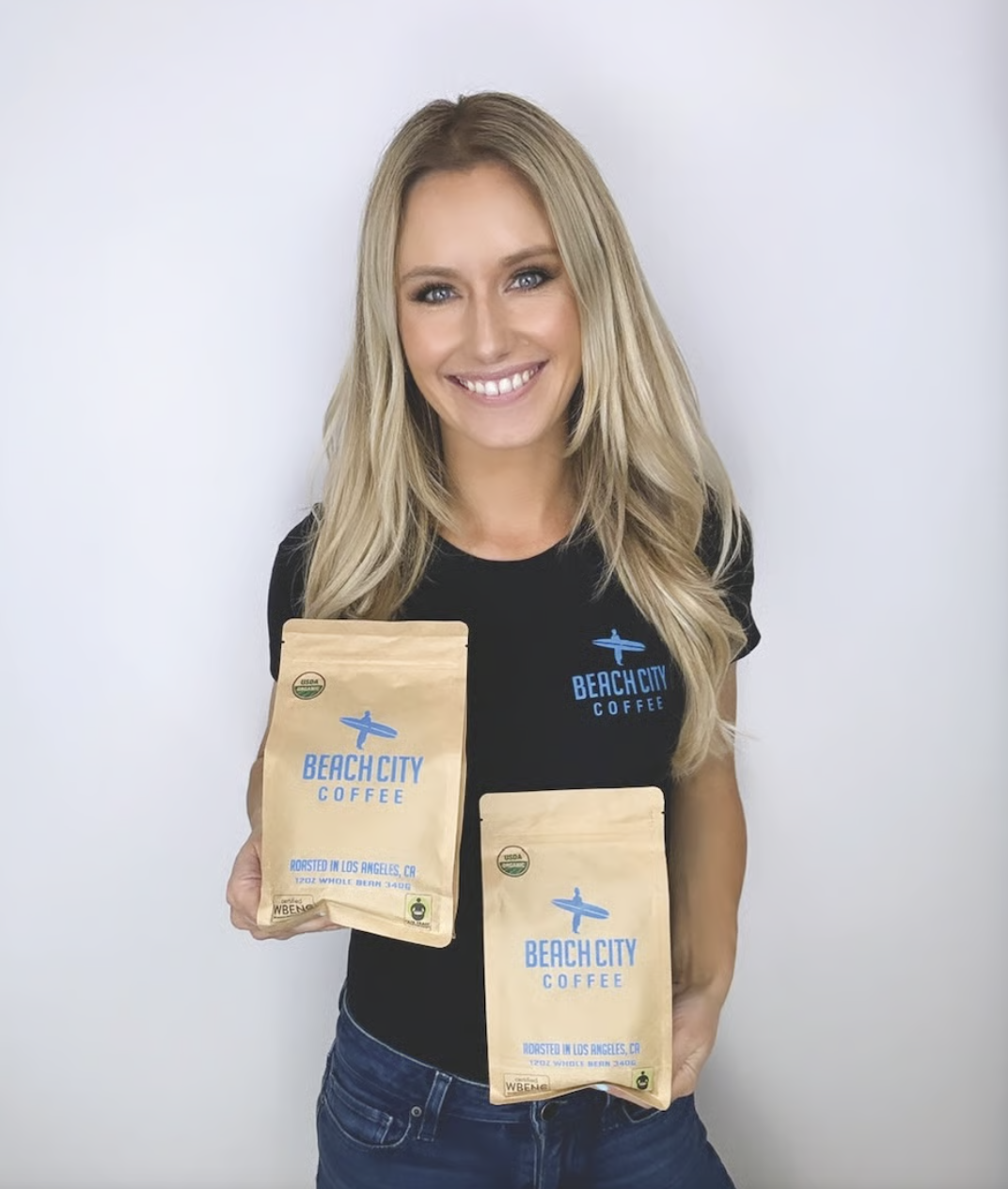
As the founder of Beach City Coffee, Jillian has spent 17 years growing what began as a coffee-roasting experiment with an old popcorn popper into a women-owned coffee brand now found in major retailers, including Whole Foods, Walmart, Kroger, Ralphs, Frys, and King Soopers. But the deeper lesson of her story is not simply that she moved from a Santa Monica shed to hundreds of retail shelves. It is that she built Beach City Coffee by refusing to separate business growth from the values that shaped the company’s beginning: fresh specialty coffee, fair trade organic sourcing, compostable packaging, community connection, and a founder’s unwillingness to let a crowded category dictate what was possible.
“We weren’t an overnight success. We’re years and years in the making. And it’s so much persistence that it takes to get somewhere.”
That sentence should sit with any founder, executive, or leader who has ever watched someone else’s launch, expansion, media moment, or retail placement and assumed the climb was cleaner than it really was. Beach City Coffee’s growth was not the result of a lucky shelf placement or a single brilliant pitch. It was built through years of experimentation, rejection, operational learning, and a disciplined belief that the company could compete without becoming a generic version of the brands already dominating the category.
The First Advantage Was Not Capital. It Was Proximity.
Beach City Coffee did not begin as a polished consumer packaged goods company. It began with Jillian and her now husband, Julian, roasting coffee while they were still in college, using an old-school popcorn popper with an open top and a wooden dowel to mix the beans. It was unorthodox, imperfect, and, by Jillian’s own admission, odd enough that neighbors wondered what they were doing. But that strange little experiment gave them something many founders lose too quickly: a direct, intimate relationship with the product.
Fresh coffee became the first revelation. Seventeen years ago, specialty-grade coffee was not widely available in grocery stores, and freshly roasted coffee was even harder to find in mainstream retail environments. Once Jillian and Julian started roasting their own beans, the difference was obvious. Friends and family began asking for it. Tech offices became early customers. What started as curiosity became a repeatable product, and what began as a product slowly became a business.
This proximity mattered because it shaped the company before the company had a formal structure. Jillian learned the sensory side of coffee through repetition, intuition, and experience. She learned what a roast should look like, how freshness changed the cup, and how the quality of green beans, storage, roasting profile, grinding, and brewing all influenced the final experience. Later, when she hired a Q grader, the coffee equivalent of a sommelier, she joked that her roaster had the book smarts while she had the street smarts. That distinction is important. Jillian’s expertise was not theoretical; it came from doing the work long enough to trust her judgment.
In a crowded category, founders often look for differentiation in brand positioning first. Jillian’s story suggests that true differentiation often begins much earlier, inside the founder’s relationship with the product. Before Beach City Coffee had national retail placement, it had a founder who understood the craft deeply enough to know what she was protecting.
When the Market Disappeared, the Mission Had to Find a New Channel.
Before retail became the growth engine, Beach City Coffee sold primarily to tech offices in Santa Monica. That market worked well for a long time, until COVID shut offices down and the company’s primary revenue stream disappeared almost overnight. Jillian suddenly had a large coffee roaster and no clear path to the customers who had sustained the business.
This was the kind of disruption that forces founders to separate the business model from the business itself. The office channel was broken, but Beach City Coffee was not. The demand for quality coffee still existed. The values still mattered. The product still had a place in people’s daily lives. The question was whether Jillian could move the same underlying business into a new commercial environment.
Retail became the answer, but not because it was easy or obvious. Jillian targeted Whole Foods first because it was her dream retailer and because she believed the company supported local brands. She did not assume she would get in. Instead, she treated every sample as if it mattered and used the same scrappy LinkedIn strategy that had helped her reach office customers. She reached out to people connected to Whole Foods, sent samples to anyone willing to receive them, and trusted that if the product reached enough internal advocates, it might eventually find its way to the right buyer.
That strategy was not glamorous, but it was deliberate. Rather than immediately relying on brokers, Jillian chose to sell the product herself, partly because brokers would add cost to a business already trying to stay price competitive while using fair trade organic coffee and better packaging. More importantly, she understood that a broker selling a portfolio of products could not replicate the conviction of a founder selling her own.
That choice reveals a useful lesson for founders in any industry: sometimes the constraint that forces you to do something yourself becomes the very thing that makes the pitch more powerful. Jillian did not have the scale or margin structure of the largest brands, but she had the story, the product knowledge, and the credibility of someone who had built the company from the ground up.
Sustainability Became an Operating Decision, Not a Brand Claim.
One of the most important strategic through lines in Beach City Coffee’s story is packaging. Jillian was bothered early by the waste she saw in the coffee industry, especially around single-use packaging and products that appeared responsible but did not actually solve the problem. She first tried recyclable packaging, only to discover that her own city did not recycle the type of packaging she was using. That experience introduced her to the problem of “wish-cycling,” where consumers believe they are recycling responsibly, but the materials ultimately cannot be processed by their local system.
That realization changed the standard. Recyclable was not enough if it did not actually get recycled. Compostable became the goal.
Jillian eventually found a 60% compostable bag, which still required the consumer to remove the valve and tin tie, and then continued searching until she found a 100% compostable option made with craft paper and a high-barrier PLA bioplastic. The result was packaging aligned more closely with Beach City Coffee’s environmental mission, but it also introduced new operational complexity. Bags that actually break down create different storage and shelf-life challenges. Better packaging is rarely easier packaging.
This is where sustainability moves from aspiration to strategy. Many companies want to be perceived as environmentally responsible, but fewer are willing to make sourcing, packaging, pricing, manufacturing, and education decisions that support that claim under real commercial pressure. Jillian’s commitment to fair trade organic coffee and compostable packaging has direct margin implications, especially in a market where consumers are highly price-sensitive and coffee is purchased frequently.
Her solution has been to control more of the manufacturing process herself, keeping other costs lean so the company can continue offering values-aligned coffee at a price consumers can reasonably access. That decision also helps explain why Beach City Coffee has remained bootstrapped. Outside capital might have accelerated some parts of growth, but self-funding has allowed Jillian to maintain control over the values she refuses to trade away.
“At the end of the day, I have full control over, you know, if I want to keep compostable bags and fair trade organic coffee, I can do that.”
That kind of control is not theoretical. It shows up when tariffs pressure margins, when a spouse or advisor asks whether the most expensive sourcing standards are still realistic, and when the founder has to decide whether values are flexible or foundational. For Jillian, fair trade organic coffee and compostable packaging are not decorative elements of the brand. They are the business.
Retail Growth Requires Systems, Not Just Shelf Space.
Getting into a major retailer is often treated as the finish line for consumer brands, but Jillian’s experience makes clear that shelf placement is only the beginning of a different and more demanding game. When Beach City Coffee first launched into Whole Foods, the company started with 61 stores and one SKU. That was a major milestone, but it also exposed the operational demands of retail at scale.
Jillian quickly learned that getting onto the shelf did not mean the product would automatically stay there. After visiting her local Whole Foods and discovering that Beach City Coffee was not on the shelf, she realized the store simply had not reordered. That created an immediate revenue risk and revealed a gap in the company’s retail operations. If coffee was out of stock for a week, that was not a minor inconvenience; it was lost revenue, lost trial, and lost momentum.
Julian, whose background in tech allowed him to support the business in targeted ways, built an online dashboard that tracks Beach City Coffee’s products in every store every day. That system allows Jillian to see when a product has been out of stock in a specific location and follow up before the problem becomes invisible damage.
This is one of the most instructive parts of the story because it shows the shift from founder grit to operational infrastructure. Early-stage persistence may get a product into the room, but systems keep it alive once it gets there. Retailers have portals, onboarding requirements, reorder patterns, compliance processes, and data gaps that can overwhelm small brands that are not prepared. Jillian’s ability to pair founder-led sales with practical systems helped Beach City Coffee avoid becoming a brand with a great story and poor execution.
The same pattern applies to sampling. In Whole Foods, Jillian and her team were able to conduct demos themselves, which allowed them to communicate directly with customers about the coffee, the compostable bags, and the fact that the company is women-owned. As the brand expanded into retailers where she could not personally demo, she had to translate that direct community connection into training, written materials, brand ambassador education, and marketing that could carry the message without her standing there.
Scale, in other words, required her to codify what had previously lived in her presence.
Women-Owned Was Not a Label. It Became a Doorway and a Mirror.
Jillian did not enter coffee with a grand theory about gender in the industry, but as she spent more time in roasting and ownership spaces, she saw how underrepresented women were. That awareness became part of how she understood the business and, over time, part of how the market understood Beach City Coffee.
The company’s women-owned status, supported by WBENC certification, helped create credibility with retailers that wanted to know the claim was legitimate. But the deeper significance was not only access. It was identity. Jillian discovered that many customers wanted to champion women-owned brands, and that response became one of the unexpected joys of growing the business.
Her story about the broker who told her she needed his help because a retailer was an “old boys club” captures a larger shift happening across industries. Rather than accepting his framing, Jillian looked up the coffee buyer herself and discovered the buyer was a woman. She used the moment, carefully and strategically, to start a conversation, and Beach City Coffee moved to the front of the retailer’s review list.
The lesson is not that old barriers have disappeared. They have not. The lesson is that founders can sometimes turn lazy assumptions into strategic openings when they refuse to internalize someone else’s outdated map of the market.
For women founders, especially those operating in categories where ownership, capital, distribution, and technical expertise have historically skewed male, that distinction matters. Jillian’s confidence was not performative. It came from years of doing the work, learning the product, sending the samples, navigating the portals, building the team, and standing behind the company’s values when easier choices were available.
Culture Is the Founder’s Values Under Pressure.
As Beach City Coffee grew, Jillian faced one of the hardest transitions in any founder-led company: building a team around work she once did herself. She had roasted the coffee personally, which made delegation emotionally complicated. The product was not just inventory; it was her craft, her reputation, and her promise to the customer. Letting others into that process required trust, training, and a willingness to accept that mistakes would happen.
Her first two hires, both women, remain with the company today. In the early days, they might work one hour in a slow week or 12 to 14 hours when a large order came in, and they stayed through the unpredictable grind of a growing manufacturing business. Their loyalty became a form of institutional knowledge, and Jillian now understands how rare and valuable that kind of commitment is.
When asked what makes a strong culture, Jillian pointed first to belief. If she believes in herself and in what Beach City Coffee is building, she can help buyers, employees, and customers believe in it too. She also named positivity, not as shallow optimism, but as an operating posture that shapes the energy people bring into the work. Positivity, in her view, is infectious; it makes people want to work hard, stay engaged, and keep going when the business becomes difficult.
But her most memorable cultural principle may be this:
“No just means yes later.”
That line is more than motivational language. It reflects a founder’s relationship with rejection. In retail, in sales, in capital conversations, in hiring, and in growth, rejection is constant. If every no is interpreted as final, the founder becomes brittle. If every no is treated as information, timing, or a future opening, persistence becomes strategic rather than emotional.
The Strategic So What?
Beach City Coffee offers a clear lesson for modern founders and executives: differentiation is strongest when it is operational, not ornamental. A company does not become values-led because it uses the right language on its website or packaging. It becomes values-led when its commitments shape sourcing, manufacturing, pricing, hiring, sales strategy, customer education, and the tradeoffs it is willing to absorb in order to remain coherent.
For founders building in crowded markets, Jillian’s story suggests that community should not be treated as a soft advantage. It is infrastructure. Community provides feedback, trust, storytelling power, early customers, retail validation, brand ambassadors, and resilience during periods of disruption. But community only becomes strategic when the company stays close enough to listen and disciplined enough to respond.
Her story also shows that pivots work best when they preserve the core. Beach City Coffee did not abandon its identity when office sales disappeared during the pandemic. It changed the channel, not the mission. That distinction matters for any leader navigating disruption. The question is not only what must change, but what must remain true for the company to still be worth building.
Finally, Jillian’s path reminds us that scale does not have to erase origin. The strongest founder-led companies are not the ones that cling to the past or abandon it. They are the ones that understand which early principles are strategically powerful enough to carry forward, and then build the systems, retail relationships, team culture, and operational discipline to carry those principles into a larger market.
To hear Jillian Salinas share more about building Beach City Coffee, growing from backyard roasting to national retail, navigating sustainability in consumer products, and staying rooted in purpose while scaling, listen to the full conversation on the Badass Women in Business Podcast and explore more stories through the proveHER Blogcast.