Anna Perks on Building a Business by Taking Houses Apart and Putting Herself Back Together
Building a Business by Taking Houses Apart
Most businesses don’t start with a fully formed plan. They start with a moment that lingers long enough to demand attention. For Anna Perks, that moment came during an ordinary walk through her West Denver neighborhood, when she watched a historic home being bulldozed and its materials discarded without a second thought. Windows, doors, cabinets, appliances, and hardwood floors were tossed into a dumpster as if none of it held any remaining value.
That image stayed with her, not because it was dramatic, but because it felt deeply wrong.
Seeing Waste Differently Before Construction Ever Entered the Picture
At the time, Anna was not working in construction. She wasn’t a contractor or a developer. What she did have was a long history of thinking about waste in ways most people never have to. Her background in international development, her service in the Peace Corps in Paraguay, and her work in sustainability and waste policy in Colorado had already taught her something fundamental: when trash is out of sight, it’s also out of mind. Americans, in particular, are insulated from the consequences of what they throw away.
We recycle cans and bottles. We donate old clothes. And yet, we throw away entire houses.
Asking Better Questions Instead of Accepting “This Is Just How It’s Done”
Instead of letting the moment pass, Anna did what she has always done when something doesn’t make sense. She started asking questions.
She talked to the excavator operator on the site. She reached out to the developer. She asked how demolition decisions were made and whether alternatives existed. The answers were mostly indifferent. This was just how it was done. Buildings came down quickly so new ones could go up. Speed and convenience dictated the process, not preservation or reuse.
That answer wasn’t enough.
Discovering Deconstruction and the Gap No One Was Filling
What followed was months of research and informational interviews. Anna spoke with waste experts, contractors, policymakers, nonprofit leaders, and sustainability advocates. Through those conversations, she learned about deconstruction, a methodical approach to taking buildings apart so materials can be salvaged, reused, donated, or recycled rather than crushed and buried.
Deconstruction is slower than demolition. It requires planning, labor, and coordination. But it also keeps massive amounts of material out of landfills and puts value back into circulation. It treats buildings not as obstacles to remove, but as assets to be carefully harvested.
At first, Anna assumed her role might be advisory. She could help others do this work better. But as she continued digging into the industry, an uncomfortable realization emerged. Very few companies were actually offering deconstruction services, especially in Colorado.
The gap wasn’t theoretical. It was operational.
Starting a Business Without the “Right” Credentials
So Anna made a decision that would shape the next seven years of her life. Instead of consulting from the sidelines, she would build the company herself.
Starting Perks Deconstruction meant stepping into an industry she didn’t come from. She didn’t grow up on job sites or study construction management. What she had instead was a willingness to learn publicly and imperfectly. She took construction classes at night, taught herself estimating, studied contracts and scopes of work, and leaned heavily on mentors. She cold-called deconstruction businesses in cities like Portland and Chicago and asked basic questions without pretending she already knew the answers.
How do you price this work?
What did you get wrong in year one?
What mistakes cost you the most?
She also made plenty of her own.
Learning Through Slow Growth and Early Mistakes
The first year was slow. Anna worked another job while researching and building the foundation of the business. She incorporated in March and left her job later that summer, earlier than she likely should have. Their first full deconstruction project came with painful lessons around scope and expectations. Nothing catastrophic, but nothing smooth either.
What carried her through wasn’t confidence. It was momentum. She kept going.
The Weight That Comes With Building Something That Lasts
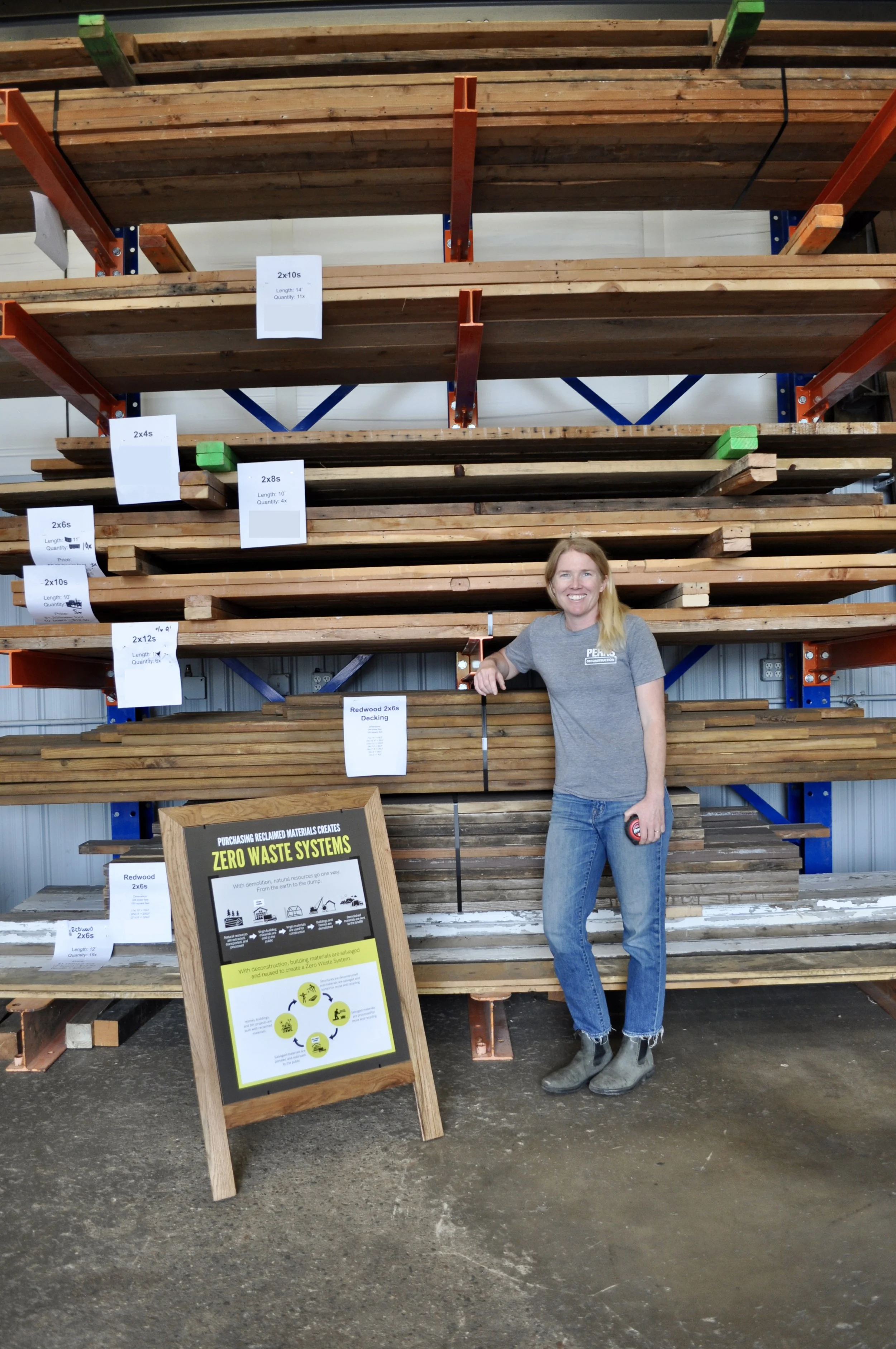
As Perks Deconstruction grew, so did the complexity of the work. The company expanded beyond small projects into full-scale deconstruction jobs. A warehouse for reclaimed materials opened in Commerce City. The team grew steadily, eventually reaching around 20 people, scaling to 25 during peak seasons, with plans to grow further.
With that growth came a different kind of pressure.
Entrepreneurship is often framed as freedom and flexibility. What’s discussed less is the weight that comes with building something that actually lasts. Payroll becomes personal. Safety becomes non-negotiable. Equipment, compliance, liability, and client expectations stack up quickly. Leadership is no longer about vision alone, but about responsibility.
When Burnout Becomes a Signal Instead of a Failure
Anna has done every job in her business at one point or another. She has driven dump trucks, managed bookkeeping, worked job sites, and closed sales. Like many founders, she learned quickly that just because you can do everything doesn’t mean you should. Carrying too much for too long doesn’t make you resilient. It makes you exhausted.
Burnout didn’t arrive in a single dramatic moment. It accumulated quietly through constant decision-making and a tendency to absorb stress so others didn’t have to. Recognizing that pattern became a turning point. Anna recognized that if the business was going to be sustainable, she had to be as well.
Delegation as a Leadership Evolution
That meant paying attention to what gave her energy and what drained it. Education, outreach, and business development energized her. Operations and administrative load did not. Delegation stopped being a nice-to-have and became a leadership necessity. Hiring an operations coordinator wasn’t just about efficiency. It was about longevity.
Growth, she learned, requires letting go.
Why Construction Waste Is a Cultural Problem
The work Perks Deconstruction does goes beyond one company or one industry. Construction and demolition waste makes up roughly one third of landfill space, yet most people never stop to consider where buildings go when they come down. The problem isn’t just infrastructure. It’s cultural.
We move fast.
We prioritize convenience.
We discard before we consider.
Policies like expanded producer responsibility and Denver’s Waste No More ordinance matter because they force accountability into systems that previously avoided it. They change incentives and make reuse and recycling part of the process rather than an afterthought. But policy alone isn’t enough. Mindset matters too.
Existing buildings are assets.
Materials have value.
Reuse is not a compromise.
Looking Ahead and Continuing to Build What Comes Next
Today, Perks Deconstruction continues to grow alongside shifting regulations and increasing demand. The reclaimed materials warehouse is expanding. Anna is exploring how technology, automation, and even robotics could make deconstruction more efficient and scalable. The business is positioned not just to respond to change, but to help lead it.
When asked what advice she would give to someone starting a business, Anna doesn’t offer a hack or a shortcut. She offers something far more honest.
Keep going.
Not because it’s easy. Not because success is guaranteed. But because meaningful businesses are built through steady persistence, through learning in public, and through refusing to look away once you see a problem clearly.
Sometimes the most impactful companies are started by people who simply decide that what they’re seeing isn’t acceptable and choose to do something about it.